

Washington is quietly dismantling crypto surveillance rules just as traditional finance giants start plugging into the chain, even while bitcoin itself can't seem to clear $87,000.
CFTC Floats a Federal Rulebook for Leveraged Crypto Trading
The CFTC opened rulemaking on a new framework — dubbed Regulation CTX and CAM — that would create a federal license for exchanges offering leveraged and margined retail crypto trading, using leverage as the trigger for oversight.
This is the regulatory equivalent of finally building a fence around a yard that's had wolves in it for a decade. Whether it's the right agency doing the fencing is still up for debate, but at least someone in Washington is drawing lines around retail leverage instead of pretending it doesn't exist.
Read more at The Block →
Treasury Quietly Kills Two of Crypto's Most Feared Surveillance Rules
FinCEN withdrew a 2020 proposal that would've forced reporting on transactions with self-custodial wallets, along with a 2023 plan to formally designate crypto mixers as a primary money laundering concern.
Two rules that once terrified privacy-minded crypto users just vanished without much fanfare. It's a reminder that in crypto policy, the scariest proposals sometimes die quietly rather than with a bang — which is either reassuring or a sign that bigger fights are being saved for later.
Read more at Decrypt →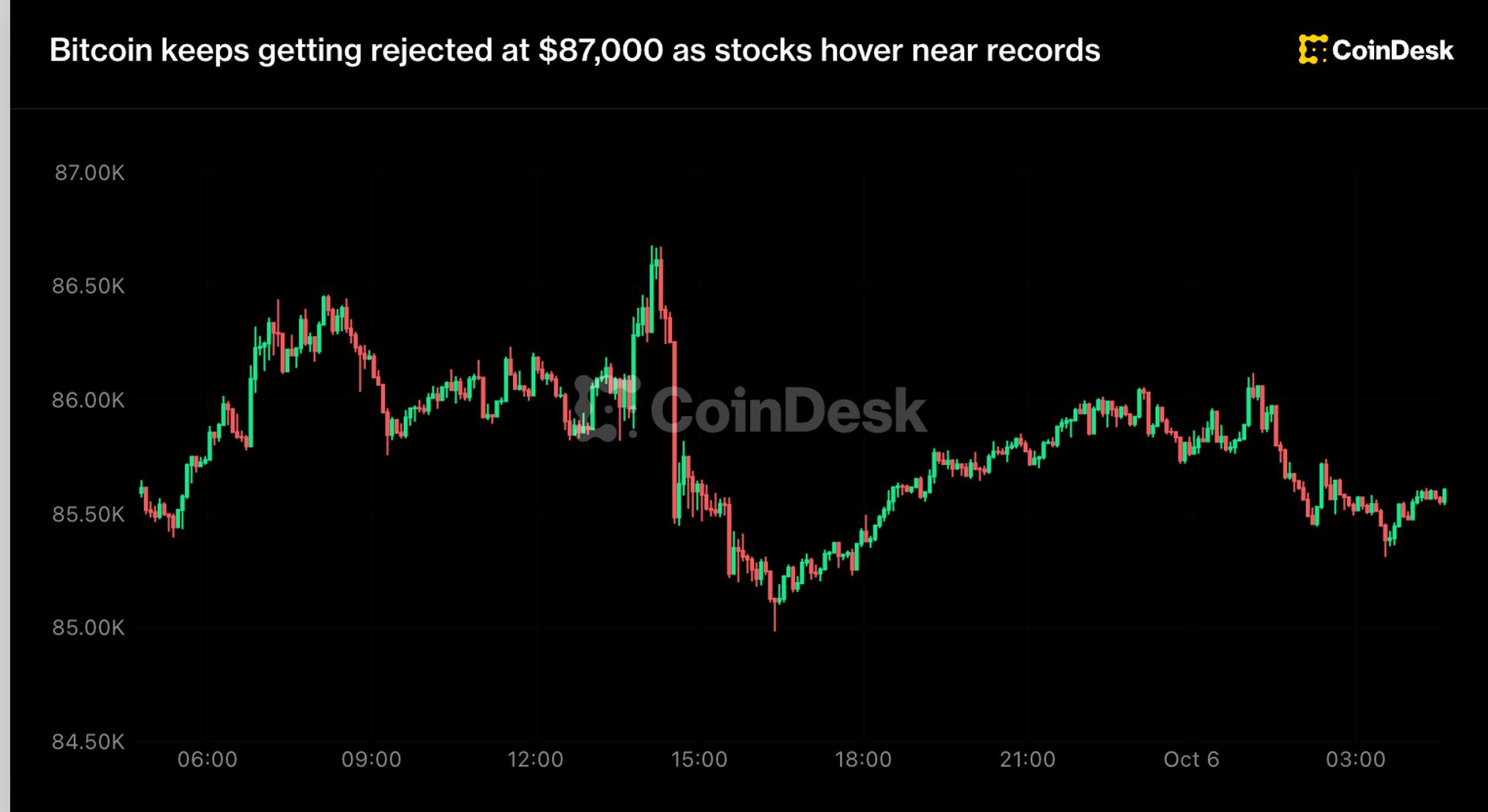
Bitcoin Keeps Bouncing Off the Same Ceiling
Bitcoin is still getting rejected at $87,000 even as stocks hover near record highs, suggesting the usual correlation between risk assets isn't translating into fresh momentum for BTC right now.
Watching bitcoin test the same level over and over without breaking through is like watching someone knock on a door that clearly isn't going to open today. Markets have their own timeline, and it rarely matches the one traders want.
Read more at CoinDesk →
One Researcher Paid $350K to Infiltrate Lazarus' Money Launderers
On-chain investigator ZachXBT says he fronted $349,700 to pose as a customer of a Chinese laundering network tied to North Korea's Lazarus Group, gathering intelligence that helped freeze funds connected to the $1.5 billion Bybit hack.
This is the kind of story that sounds like it belongs in a heist movie, except the hero is a guy with a laptop and a very specific skill set. It's also a pointed reminder that sometimes the most effective crime-fighting in crypto comes from individuals, not institutions.
Read more at The Block →
Crypto's 'Godfather' Gets Six Years for Deputies-for-Hire Fraud Scheme
Adam Iza was sentenced to six years for hiring off-duty LA sheriff's deputies to pull warrants and personal data on rivals as part of a $37 million Meta-related fraud, with proceeds moved through crypto custodians.
Using badges to do the dirty work of a fraud scheme is a new low even by crypto-crime standards. The crypto rails here were just the getaway car — the real scandal is how easily law enforcement access got weaponized for private gain.
Read more at Decrypt →
Solana Gets JPMorgan's Fingerprints on an Institutional Settlement Standard
The Solana Foundation unveiled an open-source 'DvP' program, built with input from JPMorgan, designed to let institutions settle trades atomically with finality in seconds rather than days.
When a bank like JPMorgan is quietly shaping the plumbing of a public blockchain, that's a bigger signal about where institutional finance is heading than any single price move. Settlement speed is boring until you realize how much capital is tied up waiting on it.
Read more at Cointelegraph →
Ondo Opens the Door to Tokenized Pre-IPO Exposure, Starting With AI
Ondo Finance launched a private-markets platform offering tokenized notes tied initially to a pre-IPO artificial intelligence company, giving eligible investors on-chain exposure to private company stakes.
Tokenizing access to private markets has been promised for years; actually shipping it tied to the hottest sector around is a notable test case. The real question is how much of this 'access' is genuine exposure versus a wrapper around something still fundamentally illiquid.
Read more at The Block →
Crypto's Campaign Arm Picks Its Favorites for the Midterms
Fairshake announced financial backing for 32 House candidates ahead of the U.S. midterms, continuing the industry's push to shape Congress through direct political spending.
Crypto has clearly decided that lobbying is cheaper than litigation, and the sheer number of candidates getting backed shows how seriously the industry is playing the long political game. Whether that buys policy clarity or just more noise remains to be seen.
Read more at Cointelegraph →