

Between a wallet-draining scandal, a $1 billion Iranian crypto seizure, a permanent ban for Alex Mashinsky, and a bitcoin market that can't decide what it wants to be when it grows up, this was one of those weeks that reminds you crypto's growing pains never really stop.

Ledger's Reseller Problem Just Got a $87 Million Price Tag
Ledger is investigating reports that funds were stolen from users who bought hardware wallets through a Southeast Asian reseller called CryptoBilis, with an onchain investigator tracking more than $86 million in suspected thefts. Ledger has asked the reseller to pause sales and is urging recent buyers not to even set up their devices.
Hardware wallets exist precisely to remove trust from the equation, so it's more than a little ironic when the weak link turns out to be the supply chain handing you the box. If this holds up, it's a brutal reminder that 'cold storage' is only as cold as the last hand it passed through.
Read more at Decrypt →
XRP Ledger Quietly Fixed a Bug That Could Have Minted Billions From Thin Air
Developers patched a decade-old bug in the XRP Ledger that, left unaddressed, could have allowed billions of dollars worth of XRP to be created out of nowhere. The flaw apparently sat unnoticed for years before being caught and fixed.
Decade-old bugs lurking in foundational blockchain code is the kind of headline that should make everyone a little uneasy about how much blind faith gets placed in 'battle-tested' networks. Credit where due for the fix, but it's worth asking what else has been sitting there unnoticed.
Read more at CoinDesk →
US Says It Knows Exactly Where $1 Billion in Iran-Linked Crypto Is Sitting
Treasury Secretary Scott Bessent said the US plans to seize $1 billion in crypto tied to Iran this week, the latest in a string of sanctions-related digital asset actions from the Treasury Department.
A billion-dollar seizure is a loud statement that 'untraceable' crypto has been a myth for a while now when governments actually want to find it. It also quietly reinforces that sanctions enforcement, not just regulation, is becoming a core part of how Washington engages with this asset class.
Read more at Cointelegraph →
Alex Mashinsky Is Officially, Permanently Done With Crypto
New York has permanently barred former Celsius CEO Alex Mashinsky from the industry as part of a $35 million settlement resolving a 2023 civil fraud lawsuit tied to Celsius's collapse.
It's a tidy bookend to a saga that cost a lot of ordinary depositors a lot of money, though 'permanent ban plus a payout' is a pretty mild sentence for the scale of what Celsius customers lost. Still, it's one more data point that regulators are willing to make examples stick, even years after the fact.
Read more at Cointelegraph →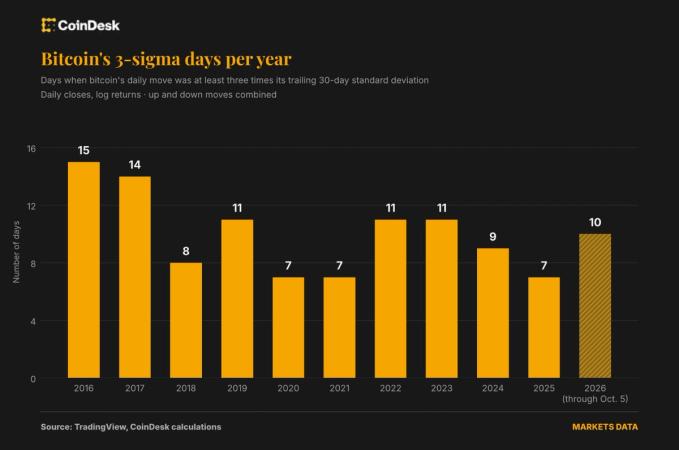
Bitcoin Is Calmer Than Ever, Except When It's Not
New data shows bitcoin's overall volatility has plunged compared to prior years, but paradoxically, extreme price swings are happening more frequently than they did back in 2018.
This is the kind of stat that sounds contradictory until you sit with it: a market can be 'boring' most days and still be prone to sudden, violent moves, which is arguably more disorienting than constant choppiness. Anyone treating bitcoin's lower average volatility as a sign the wild days are over might want to look at that second half of the finding a little more closely.
Read more at CoinDesk →
JPMorgan Says $50 Billion Has Quietly Flowed Into Crypto This Year
JPMorgan analysts estimate roughly $50 billion has flowed into digital assets so far this year, putting the market on an annualized pace of about $66 billion as momentum builds heading into the fourth quarter.
Big numbers from big banks tend to get cited as validation, and fair enough, but it's worth remembering that inflow estimates are backward-looking snapshots, not promises about what happens next. Still, when a bank like JPMorgan is the one doing the counting, it says something about how normalized crypto flows have become as a category worth tracking.
Read more at The Block →
Blockchain.com Wants to Run Its Own Prediction Market, No Middleman Required
Blockchain.com has filed for designated contract market and futures commission merchant licenses with the CFTC, which would let it operate a regulated event-contract venue directly instead of leaning on overseas partners.
Prediction markets have become one of the more contested corners of crypto regulation, and a well-known platform seeking its own US licenses rather than routing around the rules is a notable bet on where that fight ends up. It's a slow, bureaucratic path, but it's the kind of move that tends to outlast the companies that skip it.
Read more at Decrypt →
DWF Labs Affiliates Sue BitGo Over $141 Million in Alleged Early Token Dumps
Subsidiaries of DWF Labs are suing BitGo in London's High Court for $141 million, alleging BitGo sold discounted Falcon Finance and ESPORTS tokens roughly two months before their lock-up period expired, tanking the value of their remaining holdings.
Token lock-ups are supposed to be the thing that keeps early investors from torching a project's price before everyone else gets a fair shot, so an alleged early breach by the custodian itself is a pretty pointed accusation. Expect this one to become a cautionary tale about who you actually trust to hold the keys and honor the terms.
Read more at CoinDesk →
Thailand Opens the Door to Local Bitcoin and Ether ETFs
Thailand's SEC has finalized rules allowing locally listed bitcoin and ether ETFs, with the new custody, exposure, and trading requirements set to take effect October 16.
Every new country that greenlights a spot ETF chips away at the idea that regulated crypto exposure is a niche US or European product. Thailand starting narrow with just bitcoin and ether also suggests regulators elsewhere are watching how this plays out before deciding whether to widen the door further.
Read more at CoinDesk →